


AI can generate hundreds of keyword ideas in seconds. That speed is useful, but it can also create an illusion: a long list looks like research even when it is based on assumptions rather than evidence.
Real keyword research is a decision-making process. You collect signals from actual searches, understand what users want, check what already ranks, group related queries, and choose topics your website can genuinely answer.
The best approach is to let AI handle expansion, organization, comparison, and pattern recognition while reliable SEO sources provide the underlying data. This guide explains how to use AI for keyword research without guessing, including a practical workflow, prompt examples, validation steps, and common mistakes to avoid.
What “Without Guessing” Means
No keyword tool provides perfect certainty. Search behavior changes, volume figures are estimates, rankings move, and different tools use different databases. “Without guessing” therefore does not mean predicting guaranteed traffic.
It means making decisions from observable evidence instead of accepting an AI-generated claim.
A defensible keyword choice should answer five questions:
- Is the query relevant to the website and audience?
- Are real people searching for or discussing the problem?
- What does the searcher expect to see?
- Can the website create a page that satisfies that expectation?
- Is the opportunity realistic compared with the current results?
AI can help answer these questions faster, but it should not be treated as the original source of search volume, keyword difficulty, trends, or live ranking data unless it is connected to a current SEO database.
Where AI Helps and Where It Does Not
AI is strong at language work. It can expand seed topics, identify modifiers, group similar phrases, classify intent, summarize supplied SERP notes, compare competitor headings, and turn a keyword set into a structured content brief.
It is less reliable when asked to invent precise metrics. A standalone chatbot may provide plausible-looking volumes, difficulty scores, or trend claims without dependable evidence.
Use AI to expand verified topics, discover questions, identify audience segments, cluster keywords, remove duplicates, find content gaps, and draft briefs. Use real SEO tools and manual checks for volume, difficulty, trends, rankings, competitor estimates, and local demand.
A simple rule works well: AI proposes; data and SERP review decide.
Step 1: Start With a Real Audience Problem
Weak keyword research often begins with a tool. Strong keyword research begins with a problem.
Before opening an AI assistant, write down what your website helps people do. “Digital marketing” is too broad. “Help beginner bloggers plan useful SEO content” is clearer. “Help WordPress site owners improve speed without breaking their websites” is clearer still.
Define four things:
- Audience: Who is searching?
- Problem: What are they trying to understand, fix, compare, or buy?
- Outcome: What should they be able to do after reading?
- Business relevance: How does this topic support your website?
This keeps AI from expanding into attractive but irrelevant keywords. A query can have high volume and still be a poor target if it attracts the wrong audience.
Step 2: Collect Evidence-Based Seed Keywords
A seed keyword is a starting phrase used to discover related searches. Instead of brainstorming only from memory, collect seeds from places where real users reveal their language.
Useful sources include Google Search Console queries, site-search data, comments, support emails, Google autocomplete, related searches, People Also Ask, competitor headings, sales calls, reviews, forums, and established keyword tools.
Google’s Keyword Planner can help discover related terms and review estimates, although its primary purpose is advertising. Treat its figures as directional data rather than guaranteed organic traffic.
Suppose your website covers WordPress performance. Evidence may reveal seeds such as:
- speed up WordPress
- reduce WordPress load time
- WordPress caching
- improve Core Web Vitals
- slow WordPress admin
These are stronger inputs than asking for “SEO keywords about WordPress.”
Step 3: Ask AI to Expand by Search Dimension
Do not request one giant keyword list. Ask AI to expand each seed across specific dimensions. The output becomes easier to evaluate and less likely to wander off-topic.
Useful dimensions include:
- Problems: slow, broken, error, decline
- Outcomes: improve, reduce, fix, optimize
- Audience: beginners, bloggers, agencies, small businesses
- Stage: what is, how to, best, comparison, pricing, alternative
- Constraints: free, without a plugin, on mobile, for a small site
- Questions: why, when, how long, how much, which
Try this prompt:
I am researching the seed topic “speed up WordPress” for beginner website owners. Generate keyword variations by problem, desired outcome, audience, constraint, and question format. Do not provide search volume or difficulty. Return a table with keyword, likely intent, audience need, and suggested page type.
The prompt blocks invented metrics and makes the AI explain why each phrase may matter.
Step 4: Classify Search Intent Before Checking Volume
Search intent is the reason behind a query. A keyword is not useful simply because people search it; your page must match what they expect.
The main intent categories are informational, commercial investigation, transactional, and navigational. AI can make an initial classification, but important terms should be checked manually in the current search results.
If “AI keyword research tools” returns mostly comparison posts and software pages, a basic definition article will probably miss the intent. If “how to use AI for keyword research” returns detailed tutorials, a practical guide is the appropriate format.
Ask AI to flag mixed-intent terms rather than forcing every keyword into one label. Mixed intent may require a broad guide with separated sections or two different pages.
Step 5: Validate Serious Keywords With Real Data
Once AI has expanded and classified the list, validate the strongest candidates. This is where an idea becomes a research-backed opportunity.
Check Search Demand
Review estimated volume, trend direction, and target location. Do not automatically reject a relevant long-tail query because its displayed volume is small. Tools can undercount new or highly specific searches, and several related phrases may collectively create worthwhile traffic.
Inspect the SERP
Search the keyword in the target country and note:
- Dominant page type
- Content depth and freshness
- Search intent
- Major brands or specialist sites
- SERP features
- Whether smaller sites are ranking
Evaluate Value and Feasibility
A useful keyword should support both the reader and the website. Give extra weight to topics connected to your expertise, products, services, or existing authority.
Keyword difficulty scores are filters, not verdicts. Review the actual pages because a number cannot fully measure relevance, content quality, brand strength, or gaps in the current results.
The best opportunities sit where relevance, demand, intent, value, and feasibility overlap.
Step 6: Cluster Keywords by Meaning, Not Wording
AI is especially useful for keyword clustering, but it needs a clear rule: keywords belong on the same page when substantially the same answer would satisfy the searcher.
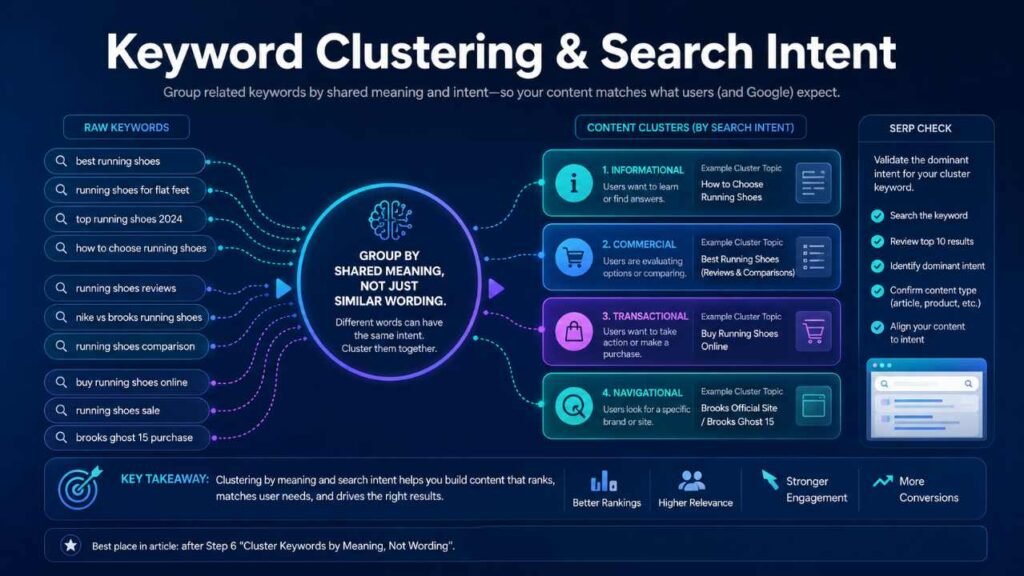
For example:
- how to use AI for keyword research
- AI keyword research workflow
- keyword research with ChatGPT
- use artificial intelligence to find keywords
These can support one comprehensive guide.
However, “best AI keyword research tools” has comparison intent and may deserve a separate page. “Free AI keyword generator” may require a tool or landing page. Similar wording does not always mean identical intent.
Ask AI to return one primary keyword per cluster, supporting variations, shared intent, recommended page type, and a reason the terms belong together.
Then map the clusters into a connected content structure. New Rize’s guide to building topic clusters for stronger internal linking explains how pillar pages, supporting articles, and contextual links can work together without creating disconnected posts.
Step 7: Prioritize With a Transparent Score
A simple scoring model prevents you from choosing keywords based on volume alone. Score each cluster from 1 to 5 for relevance, intent fit, business value, evidence of demand, feasibility, and existing authority.
AI can calculate or sort the totals after you supply the scores, but a person should approve the inputs.
A lower-volume term with strong relevance and realistic competition may be more valuable than a broad phrase with ten times the estimated searches. The goal is qualified visibility from queries your site deserves to answer.
Step 8: Turn the Winning Cluster Into a Content Brief
A content brief should connect keyword research to the reader’s task. It should not be a list of phrases to repeat.
Provide AI with the validated cluster, target audience, SERP notes, examples, and business context. Ask for:
- A concise intent statement
- The reader’s main problem and desired outcome
- Recommended H2 and H3 sections
- Questions requiring direct answers
- Concepts that need explanation
- Original screenshots, tests, or examples to include
- Relevant internal-link destinations
- Claims that require authoritative sources
- Topics to exclude because they belong elsewhere
For broader context, New Rize’s SEO ranking strategies guide helps connect keyword choices with on-page optimization, technical quality, and user experience.
Step 9: Add Internal Links Around Reader Needs
Internal links should help readers continue their journey. Do not insert a link merely because two pages contain the same keyword.
Give AI a list of published URLs, titles, and short summaries. Ask it to recommend links only when the destination provides necessary background or answers a likely follow-up question.
Check each suggestion manually:
- Does the reader need this explanation now?
- Is the destination closely relevant?
- Does the anchor text describe what they will find?
- Is this the best available page?
- Does the link interrupt or improve the reading flow?
This article naturally links to topic clustering when the workflow reaches content architecture. Placing that link in the introduction would be less useful because the reader has not reached that decision yet.
Step 10: Measure Results and Feed Data Back Into AI
Keyword research does not end at publication. Once the page receives impressions, review its real query data in Google Search Console.
Export queries, impressions, clicks, click-through rate, and average position. Ask AI to identify:
- Queries receiving impressions but lacking clear coverage
- Terms with good positions but weak click-through rates
- Unexpected subtopics that deserve a new section
- Mixed intent suggesting a separate article
- Possible cannibalization between pages
- Questions that could improve the FAQ
- New internal-link opportunities
AI becomes much more useful when it analyzes your first-party performance data instead of inventing opportunities from scratch.
For additional query discovery, guide to finding People Also Search For keywords explains manual and tool-assisted ways to uncover related questions and follow-up searches.
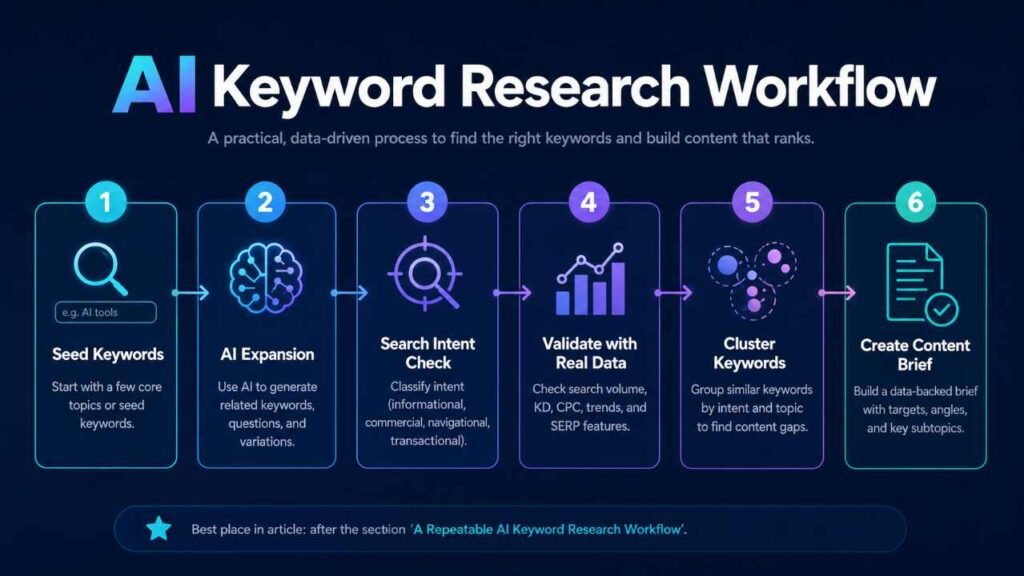
A Repeatable AI Keyword Research Workflow
Use this process for each topic:
- Define the audience, problem, outcome, and business relevance.
- Collect seed keywords from Search Console, customers, search features, and tools.
- Ask AI to expand seeds by intent, audience, problem, outcome, and constraint.
- Remove irrelevant, duplicated, branded, and off-topic suggestions.
- Classify likely intent with AI.
- Inspect the live SERP for priority terms.
- Validate demand, trends, and location with reliable tools.
- Cluster phrases that can be satisfied by one page.
- Score clusters for relevance, value, evidence, and feasibility.
- Create a content brief from validated inputs.
- Add only useful internal and external links.
- Publish, measure real queries, and update the page.
This process produces fewer keywords than an instant AI list, but the remaining opportunities are far more actionable.
Common AI Keyword Research Mistakes
Asking AI for “Easy Keywords”
“Easy” depends on your website, competitors, authority, and the live SERP. Ask for possible long-tail angles, then validate them.
Accepting Invented Search Volume
Never build a content plan around unsupported numbers generated in conversation. Use a recognized data source and record the country and date.
Creating One Page for Every Variation
Closely related wording can often be served by one strong page. Separate pages by meaning and intent, not tiny phrasing differences.
Choosing Volume Over Relevance
Broad traffic may create weak engagement and no useful outcome. Prioritize the people you can genuinely help.
Ignoring Current Results
The live SERP shows the format, competition, and expectations a keyword list cannot fully explain.
Removing Human Judgment
AI can organize evidence, but it does not know your experience, customers, limitations, or strategic priorities unless you provide them.
Prompt Template for Data-Grounded Research
Use this after collecting real seeds and metrics:
Act as a keyword research analyst. I will provide verified seed keywords, tool metrics, target country, audience, existing URLs, and notes from current search results. Do not invent missing data. Group keywords by shared intent and required answer, not merely similar wording. For each cluster, provide a primary keyword, supporting terms, intent, page type, audience problem, business relevance, possible internal links, and validation concerns. Flag uncertain classifications for manual review.
The line “Do not invent missing data” turns the AI from a pretend source into an analyst working with evidence.
Frequently Asked Questions
Can ChatGPT Do Keyword Research?
ChatGPT and similar tools can expand seed topics, classify intent, cluster phrases, analyze supplied SERP notes, and create content briefs. They should not be treated as authoritative sources for live volume, difficulty, rankings, or trends unless connected to a current database.
Is AI Keyword Research Accurate?
It can be accurate for language analysis and organization when the inputs are good. Accuracy falls when AI is asked for unsupported metrics or current SERP claims without live data. Validate important decisions manually.
How Many Keywords Should One Page Target?
A page should target one clear intent and a natural cluster of related terms. There is no fixed number. Several aligned phrases may belong together, while two similar-looking phrases may need separate pages if users expect different results.
What Free Data Sources Can Beginners Use?
Start with Google Search Console for your own query data, Google search features for language and intent clues, and Keyword Planner for directional estimates. Free versions of established SEO tools can add more ideas.
Can AI Replace an SEO Professional?
AI can reduce repetitive work, but it does not replace strategic judgment, subject expertise, original research, SERP interpretation, or accountability for the final decision.
Final Takeaway
Learning how to use AI for keyword research without guessing requires a clear division of labor. Let real search data, customer language, and current results provide the evidence. Let AI expand, classify, cluster, compare, and organize that evidence.
The winning workflow is not “ask AI for keywords and start writing.” It is: collect real signals, use AI to find patterns, validate the opportunity, match search intent, build the right page, and improve it with performance data.
Used this way, AI does not replace keyword research. It makes disciplined keyword research faster, clearer, and easier to repeat.