

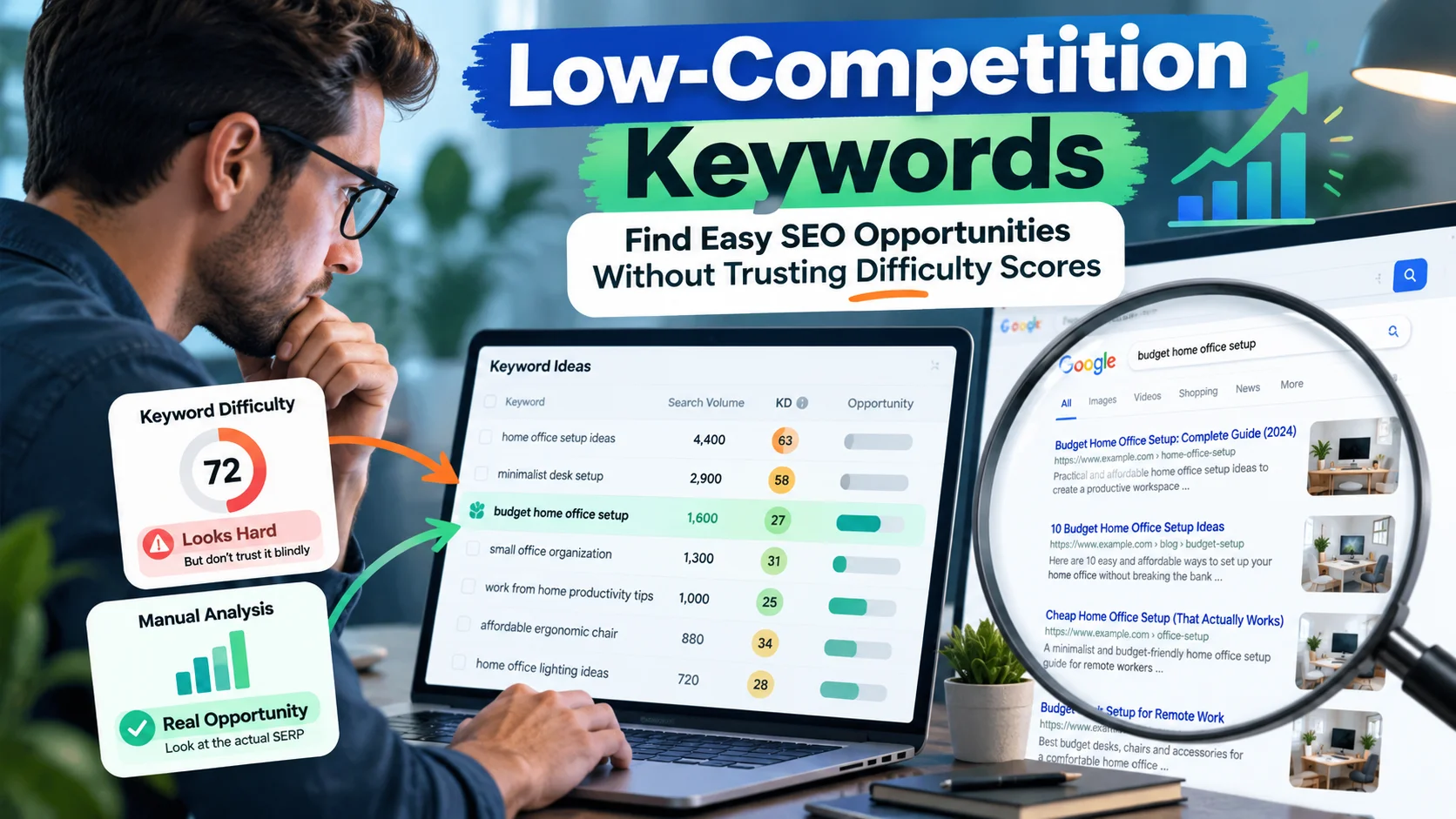
Finding low-competition keywords sounds straightforward until two SEO tools give the same query completely different difficulty scores. One platform may label a keyword easy while another treats it as moderately competitive, leaving you unsure whether the opportunity is real or merely a difference in methodology. The bigger problem is that a number cannot fully explain who currently ranks, why those pages rank, what searchers expect, or whether your particular website can compete. If you choose keywords only because a dashboard shows a reassuring score, you can spend days producing content for a search result that was never realistically open to you. A better approach is to treat the live search results as evidence and evaluate competition in context.
You can find low-competition keywords without trusting difficulty scores by combining search intent, SERP analysis, first-party data, competitor relevance, content gaps, and your site’s existing topical strengths. This does not mean keyword tools are useless; they remain excellent for generating ideas, estimating demand, and organizing large datasets. The difference is that a difficulty score becomes an optional filter rather than the final decision-maker. In this guide, you will learn a repeatable way to identify promising keywords, reject deceptive “easy” opportunities, and decide whether a query is worth turning into a page. The goal is not to predict rankings with certainty, but to make keyword decisions from observable evidence rather than a single proprietary metric.
What Low Competition Actually Means in SEO
A low-competition keyword is not simply a phrase with a low number beside it. In practical SEO, it is a query where your website has a reasonable path to producing a result that matches the searcher’s need at least as well as the pages Google is currently showing.
Competition Is Relative to Your Website
The same keyword can represent very different opportunities for two websites. A specialist site with years of relevant content, internal links, and recognized expertise may be well positioned for a query that would be unrealistic for a brand-new general blog. Your existing topical coverage, audience fit, page quality, reputation, and ability to produce the expected content format all matter. That is why the useful question is not “Is this keyword easy?” but “Is this search result realistically competitive for a site like mine?”
The Search Results Are the Competitive Environment
Difficulty scores summarize selected data, while the actual SERP shows the pages you would need to compete against. Google explains that its ranking systems consider many factors and signals rather than reducing ranking decisions to one universal difficulty metric. The practical implication is important: backlinks or authority indicators can matter without telling the entire story. Reviewing Google’s documentation on Search ranking systems gives useful context for why no third-party number can perfectly describe your chances of ranking.
Low Competition Does Not Mean Guaranteed Rankings
Even an apparently weak SERP can change after you publish. Competitors update pages, new sites enter the results, Google can interpret the query differently, and your page still needs to satisfy technical, relevance, quality, and usability expectations. Think of low competition as lower observable resistance rather than a promise of an easy ranking. Your job is to improve the odds by choosing situations where the evidence is favorable before investing in content.
Why Keyword Difficulty Scores Can Mislead You
Keyword difficulty can be useful for narrowing thousands of ideas into a manageable shortlist, but it becomes dangerous when treated as a verdict. Different tools use different databases, formulas, assumptions, and competitive signals, so the number should be interpreted as an estimate produced by that particular platform.
Different Tools Are Answering Slightly Different Questions
A difficulty score usually represents a tool’s model of how challenging it may be to reach prominent organic positions. One provider may emphasize backlink strength, while another may combine authority signals with additional characteristics of the current results. This means a score of 20 in one platform should not automatically be treated as equivalent to 20 elsewhere. If you switch tools, compare opportunities within each tool’s methodology rather than assuming the scales are interchangeable.
A Number Compresses Too Much Information
Consider everything hidden behind one difficulty value: search intent, page type, brand strength, freshness, content depth, result relevance, backlinks, SERP features, localization, and the suitability of your own website. Compressing those variables into one number is convenient, but convenience removes context. You still need to know whether the first page consists of dedicated answers or loosely related pages that happen to rank. Manual SERP inspection restores the information the score cannot show you.
Search Intent Can Make an “Easy” Keyword Impossible for the Wrong Page
Suppose a tool labels a keyword easy, but Google primarily returns ecommerce category pages. Publishing a 3,000-word informational blog post is unlikely to solve the format mismatch simply because the difficulty number is low. The reverse can also happen: a keyword may have stronger domains in the results, yet several pages only partially satisfy a narrow informational need. Matching the expected purpose and format is therefore part of competition analysis, not a separate task you perform after choosing the keyword.
Strong Domains Can Still Produce Weak Individual Results
Seeing recognizable websites in the top ten should make you investigate, not automatically abandon the keyword. A large domain may rank with an old, generic, or tangential page because nobody has produced a stronger dedicated answer yet. However, do not assume every imperfect page from a large site is easily beatable; brand recognition, links, topical relevance, and other signals may still make it resilient. The opportunity becomes more persuasive when several results show weaknesses rather than one isolated page.
Start With Search Intent Before Measuring Competition
Before you decide whether a keyword is competitive, determine what Google appears to believe the searcher wants. Competition only makes sense relative to the type of page required to satisfy that intent.

Identify the Dominant Page Type
Search the keyword and classify the results before reading them deeply. Are you seeing tutorials, product pages, category pages, comparison articles, tools, forum discussions, videos, local businesses, or official documentation? When most high-ranking results share a format, that is a strong clue about the expected experience. If you cannot realistically create that type of page, a weak-looking SERP may still be a poor opportunity.
Identify the Actual Problem Behind the Phrase
Two keywords containing almost identical words can represent different tasks. “WordPress backup plugin” may imply product comparison, while “how to restore a WordPress backup” clearly requires procedural help. Read titles, snippets, headings, and the pages themselves to determine the outcome searchers are being offered. Choose a keyword only when the intended page you can create aligns with that outcome.
Watch for Mixed Intent
Some result pages contain several competing interpretations, such as tutorials, product pages, and discussions appearing together. Mixed intent can create an opportunity because Google may still be testing what satisfies users, but it also makes the query less predictable. Look for a clear segment of the results that matches the audience and page type you can serve. If the SERP shifts dramatically when wording changes slightly, consider targeting the more specific variation instead.
How to Find Low-Competition Keywords Step by Step
The most reliable workflow separates discovery from validation. Generate a broad set of relevant opportunities first, then manually investigate only the candidates that fit your site and audience.
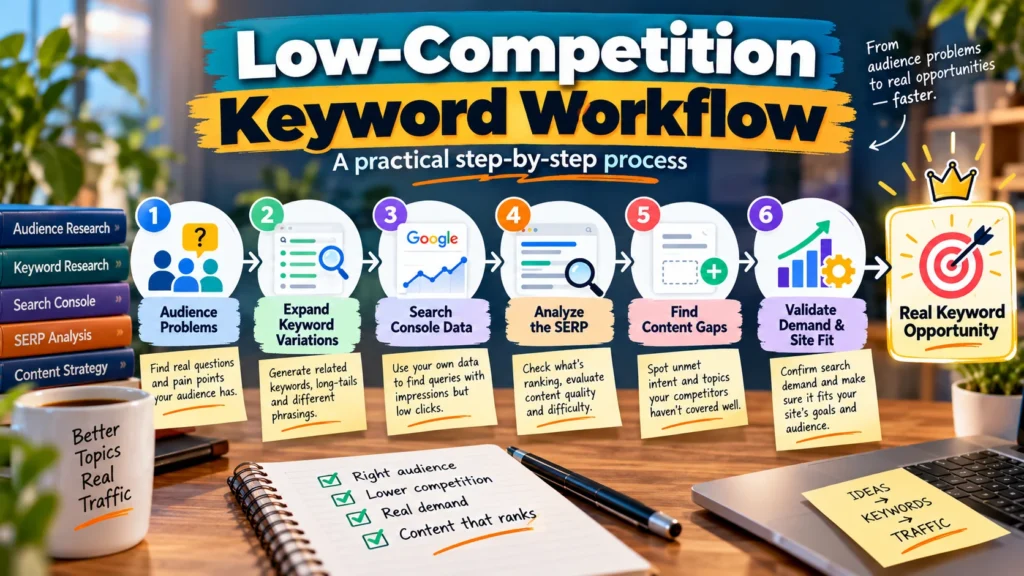
Step 1: Start With Problems Your Audience Actually Has
Begin with the tasks, frustrations, decisions, and questions your audience encounters rather than typing a broad industry term into a tool and sorting by difficulty. A site about blogging might begin with problems such as finding topics, improving old articles, fixing indexing issues, choosing WordPress tools, or building internal links. Problem-first research keeps the resulting keywords tied to subjects your site can credibly help with. If you need a broader framework for generating and validating keyword ideas, This guide to using AI for keyword research without guessing covers that upstream research process in more detail.
Step 2: Expand Each Problem Into Specific Search Situations
Take one audience problem and explore variations based on conditions, audience, desired outcome, stage of knowledge, and constraints. Instead of stopping at “keyword research,” you might investigate questions involving new websites, free methods, existing Search Console data, zero-volume terms, local markets, or evaluating competition manually. Specificity often exposes search needs that broad competitors have not addressed directly. Do not assume a longer phrase is automatically easier, however; every serious candidate still needs SERP validation.
Useful expansion patterns include:
- Audience: for beginners, bloggers, ecommerce sites, local businesses, agencies
- Constraint: without paid tools, without backlinks, with a small site, using free data
- Problem: not ranking, declining traffic, conflicting metrics, unclear intent
- Outcome: find opportunities, validate demand, choose a page type, prioritize content
- Comparison: method A vs. method B, tool data vs. manual review
- Question: how, why, when, which, what happens if
Step 3: Use Search Console When Your Site Already Has Visibility
For an established website, your own query data can reveal opportunities that generic keyword databases miss. Look for relevant searches where Google is already showing one of your pages but where the page has not yet captured its full potential; then investigate whether the existing URL partially answers the intent or whether the query deserves a dedicated page. Google notes that Search Console’s query dimension contains the search terms associated with your Search visibility, although some queries are anonymized or omitted because of reporting limitations. For a complete workflow, this explains how to turn Search Console queries into an evidence-based update brief.
Google’s Search Console Performance report documentation is worth reviewing before treating exported query data as exhaustive.
Step 4: Search the Candidate in the Market You Actually Target
Open the search results for the target query and evaluate the country, language, device context, and local intent that matter to your audience. Search results can vary by location and context, so a SERP observed in one market should not automatically determine a strategy for another. Record the first-page page types, not just the domains, and note any prominent SERP features such as videos, local results, shopping elements, discussions, or direct-answer experiences. You are trying to understand the battlefield your content would actually enter.
Step 5: Look for Repeated Weakness, Not One Weak Result
One questionable result is not enough evidence that a keyword is low competition. Look for several pages that are only partially relevant, outdated where freshness matters, too broad for the query, poorly aligned with the likely intent, or missing information that appears necessary to complete the searcher’s task. Forums and community discussions can signal an underserved question, but they are not automatically weak; sometimes a discussion is exactly what the searcher prefers. The strongest opportunity exists when multiple observations point in the same direction.
Step 6: Compare the Ranking Sites With Your Own Position
Do not ask whether competing domains are objectively strong; ask whether they are meaningfully stronger than your site in this subject area. A small specialist site may compete effectively against larger general publishers for a narrow problem when it can provide a more focused answer, while a new general site may struggle even against modest specialist competitors. Check whether sites similar to yours already appear anywhere in the first page or nearby results. Their presence does not guarantee success, but it is useful evidence that Google is not restricting the query to one class of dominant publishers.
Step 7: Check Whether You Can Create a Materially Better Result
“Better” does not necessarily mean longer. You might improve the result by answering the intent more directly, including missing steps, presenting an original example, clarifying a confusing process, providing a useful comparison, adding screenshots, or separating information that competitors bury inside broad articles. If the current results already provide excellent, current, specialized answers, rewriting the same advice in different words is not a competitive advantage. Choose topics where you can explain exactly what your page will contribute before you start writing.
Step 8: Validate Demand Without Requiring Perfect Volume Data
Competition is irrelevant if the query has no meaningful connection to real audience demand. Use available keyword estimates, Search Console data, related searches, customer questions, community discussions, site search, or other observable signals to determine whether the problem exists. Do not require every source to show the same number because search-volume tools are estimates and very specific queries can be grouped or underrepresented. What matters is having enough evidence to justify the publishing effort relative to the value of the audience.
Step 9: Decide Whether the Keyword Needs a New Page
A promising query does not automatically deserve its own URL. Compare it with articles already published on your site and ask whether the same page could satisfy both the new term and an existing target without becoming unfocused. Creating separate pages for tiny wording variations can split signals, complicate internal linking, and create overlapping content. Our guide to building topic clusters for stronger internal linking provides a useful framework for deciding which searches belong together and which require distinct pages.
How to Judge a SERP Without a Difficulty Score
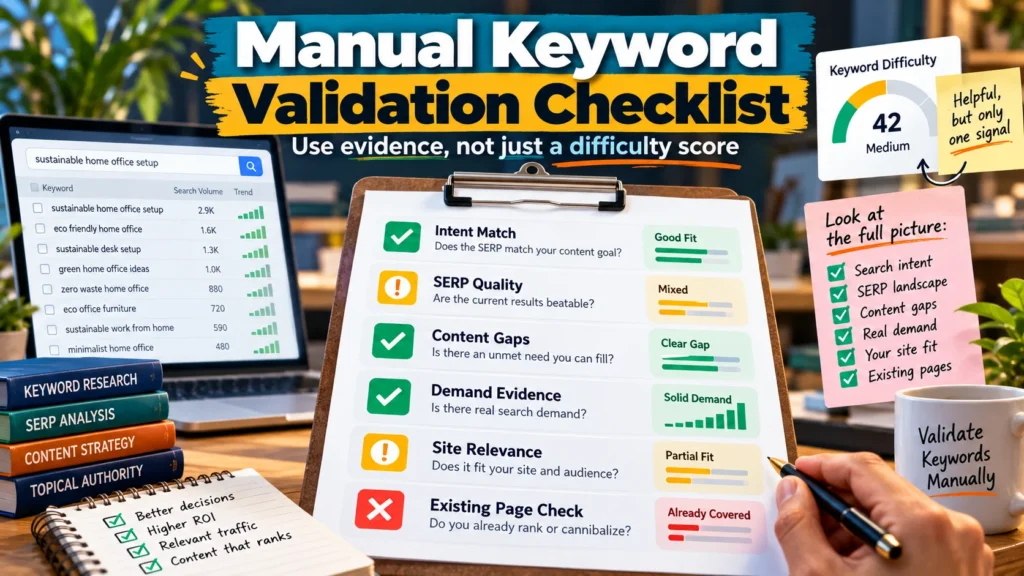
Manual analysis becomes faster when you inspect the same signals for every candidate. Instead of inventing another universal numeric score, use an evidence matrix that forces you to explain why an opportunity looks promising or risky.
Use Green, Yellow, and Red Evidence
A qualitative framework is often more useful than replacing a proprietary difficulty score with your own arbitrary formula. Mark a signal green when it supports the opportunity, yellow when the evidence is mixed, and red when it suggests substantial resistance. The objective is not to collect the largest number of green boxes mechanically. It is to identify whether the important signals tell a coherent story about your realistic ability to satisfy the query.
| Signal | Green Evidence | Yellow Evidence | Red Evidence |
|---|---|---|---|
| Search intent | Clear and easy to satisfy | Mixed but understandable | Your feasible page type conflicts with the SERP |
| Result relevance | Several results only partially answer the query | Most are relevant with minor gaps | Results are highly specific and exact |
| Content quality | Multiple pages miss important steps or context | Some weaknesses, some strong pages | Excellent specialized coverage throughout |
| Competitor fit | Comparable specialist or smaller sites rank | Mix of peers and dominant sites | Results dominated by authoritative specialists or official sources |
| Freshness | Important results are stale where recency matters | Mix of new and old | Results are current and actively maintained |
| Content advantage | You can name a concrete improvement | Advantage is modest | You would mostly repeat existing answers |
| Demand evidence | Multiple relevant demand signals | Limited but plausible evidence | Little evidence that the query matters |
| Site relevance | Strong fit with existing topic coverage | Adjacent topic | Weak connection to the site’s purpose |
Focus on Patterns Across the First Page
Do not obsess over whether position four looks weak while ignoring nine excellent competitors around it. The first page should be viewed as a set because ranking opportunities depend on the competitive pattern, not the weakest individual result. If several different domains rank with imperfect or loosely matched pages, the opening is more credible. If almost every result is purpose-built, authoritative, current, and closely aligned with the query, a low tool score deserves skepticism.
SERP Signals That Can Indicate Lower Competition
Some patterns repeatedly justify deeper investigation, although none should be treated as an automatic ranking shortcut. Their value comes from what they reveal about unmet intent or the level of specialization in the current results.
Several Results Target a Broader Topic
A narrow query may be underserved when Google has to borrow pages written primarily about a broader subject. Read the pages rather than relying on titles alone because a broad title can still contain an excellent section addressing the query. If several results mention the problem only briefly, a focused article may provide a better experience. This signal becomes particularly interesting when the query represents a distinct task that deserves its own explanation.
Titles and Content Do Not Fully Match the Query
When ranking pages repeatedly address adjacent questions instead of the exact one searched, Google may have limited specialized inventory available. That does not mean exact-match wording should be forced into your title and every heading. The opportunity is to serve the underlying intent more precisely than current pages. Make sure the difference is meaningful to the reader rather than merely lexical.
Smaller Specialist Sites Are Already Visible
The presence of niche or less prominent websites can indicate that relevance and usefulness matter strongly for the query. Examine what those pages do well before assuming they rank because competition is weak. They may have excellent topical coverage, relevant backlinks, established audience trust, or unusually strong content. Your comparison should therefore focus on whether your site can provide similar or greater subject relevance, not on domain size alone.
Current Results Leave an Obvious Task Incomplete
A useful page should help the searcher reach the outcome implied by the query. If several results explain a concept but fail to show implementation, troubleshooting, examples, limitations, or decision criteria that the user clearly needs, there may be room for a more complete result. The missing element should be central to the task rather than something added merely to make your article longer. Search competition is easier to challenge when the content advantage is concrete and useful.
Signals That an “Easy” Keyword May Be Harder Than It Looks
Some keywords appear attractive in a tool but become poor targets after a manual review. Recognizing these false positives can save more time than discovering another hundred keyword ideas.
The SERP Is Dominated by a Page Type You Cannot Match
If Google mainly returns product categories, calculators, interactive tools, local providers, official documentation, or videos, a conventional blog article may not belong in the result set. You could still target the broader topic through another query, but forcing the wrong format is inefficient. Pay particular attention to transactional and local searches because they often require assets beyond written content. A low difficulty number does not remove that structural disadvantage.
Every Strong Result Directly Satisfies the Same Intent
Competition can be intense even when the domains themselves are not famous. Ten focused specialist pages that answer the exact question may create a more difficult environment than several large brands ranking with generic content. Read enough of the competing pages to understand whether meaningful gaps actually remain. If your only differentiator is “write a longer article,” the keyword probably deserves a lower priority.
The Searcher Can Get the Answer Without Visiting a Page
Some queries can be substantially satisfied by information displayed directly on the results page or by specialized SERP features. That does not make ranking worthless, but it can reduce the value of an impression compared with a query that requires deeper information. Evaluate the expected click opportunity as part of the business case rather than looking only at estimated search volume. A keyword can be easy to rank for and still be a weak traffic opportunity.
The Topic Requires Trust You Cannot Yet Demonstrate
Certain searches place unusually high demands on accuracy, expertise, sourcing, or institutional credibility. If the topic concerns consequential health, financial, legal, safety, or similarly sensitive decisions, superficial content is a poor strategy regardless of the apparent competition level. Ask whether your site has the expertise and evidence required to publish responsibly. Finding low-competition keywords should never become an excuse to enter topics your website is not qualified to handle.
A Practical Example of Manual Keyword Validation
A hypothetical example makes the evaluation process easier to apply. The purpose is not to claim that a specific keyword currently has a particular SERP, but to show how you would reason through a candidate before publishing.
Start With the Candidate, Not the Score
Imagine a site for bloggers discovers a specific query about reducing image file size without visibly reducing quality. Instead of checking whether the keyword has a difficulty score below an arbitrary threshold, the researcher first confirms that the query fits the site’s audience and can be answered with an instructional article. They then search the phrase in the target market and record the dominant page types, relevant SERP features, and the purpose of the top results. At this stage, the candidate remains an idea rather than an approved topic.
Look for Evidence of an Opening
Suppose several results discuss general image compression, while only a few directly explain the trade-off between file size and visual quality. The researcher would inspect those pages to determine whether the gap is genuine, whether specialist sites can rank, and whether a more focused tutorial could improve on the existing experience. They would also identify what original value the new page could provide, such as side-by-side settings, a reproducible workflow, or troubleshooting advice. Only after those observations support the opportunity would demand estimates and business relevance determine its priority.
Decide Whether It Belongs on an Existing Page
Before creating a URL, the researcher searches the website for existing articles about image optimization, WordPress performance, and compression. If one article already serves essentially the same intent, improving that page may be more sensible than publishing another version. If the query represents a distinct problem with enough depth and a different reader outcome, a supporting article may be justified. This final cannibalization check prevents good keyword research from producing a messy content architecture.
A Repeatable Low-Competition Keyword Checklist
A standardized checklist keeps research consistent and prevents attractive metrics from taking control of the decision. Use it after discovery and before assigning a keyword to your editorial calendar.
Record the Evidence for Every Serious Candidate
Your notes do not need to become an elaborate SEO spreadsheet. You simply need enough information that another editor could understand why the topic was approved and what evidence supported the decision. Recording the reasoning also helps when rankings later differ from expectations because you can review which assumptions were correct or weak. A keyword should enter production only when you can explain the opportunity in plain language.
For each candidate, record:
- Query: What exact search are you evaluating?
- Target market: Which country, language, and audience matter?
- Likely intent: What is the searcher trying to accomplish?
- Expected page type: Tutorial, comparison, category, tool, landing page, or another format?
- Current SERP pattern: What kinds of pages and sites dominate?
- Weakness evidence: Which repeated gaps make the results potentially beatable?
- Risk evidence: What makes the query more difficult than it first appears?
- Demand evidence: Search estimates, Search Console, audience questions, or other relevant signals.
- Site fit: Why is your website a credible destination for this subject?
- Content advantage: What will your page do materially better or differently?
- Cannibalization check: Does an existing URL already satisfy this intent?
- Internal-link path: Which existing pages should connect to the new article?
Common Mistakes When Looking for Low-Competition Keywords
Most failures happen because a useful signal is turned into a rigid rule. Manual keyword research works best when several pieces of evidence agree rather than when one shortcut replaces another.
Sorting by Low Difficulty and Publishing Immediately
A low-difficulty filter can be a convenient discovery method, but publishing directly from that list skips the most important work. You still need to verify intent, page type, competitor quality, business relevance, and whether your site already covers the topic. Treat filtered keywords as candidates, not assignments. The live results decide whether each candidate deserves serious consideration.
Assuming Long-Tail Automatically Means Easy
Long-tail searches tend to be more specific, but specificity does not guarantee weak competition. A narrow commercial query can attract highly optimized specialist businesses because each visitor is valuable. Likewise, an obscure technical question may be dominated by authoritative documentation and experienced communities. Judge the actual results instead of using word count as a proxy for difficulty.
Treating Forums as Weak Competitors
Seeing Reddit, Quora, or a specialist forum does not automatically mean Google lacks a good result. Community discussions sometimes rank precisely because readers value firsthand opinions, troubleshooting exchanges, or multiple perspectives. Ask why the discussion satisfies the query and whether a conventional article could genuinely improve the experience. Rewriting forum answers into generic prose is not a competitive strategy.
Confusing Search Volume With Opportunity
A high-volume keyword can be commercially irrelevant, while a narrow query may reach exactly the people your site is designed to help. Search volume should therefore be considered alongside intent, business value, SERP click potential, and publishing cost. Avoid rejecting specific phrases solely because the displayed number is small or prioritizing broad terms solely because it is large. The right question is whether worthwhile demand exists for an audience you can serve.
Creating Separate Pages for Every Variation
Keywords should be separated when the reader requires a meaningfully different answer, not merely because the wording changes. Publishing near-duplicate pages creates editorial overhead and can make it difficult to determine which URL should become the site’s strongest resource for the subject. Group variations that share intent and required content into one comprehensive page. Reserve new URLs for searches that genuinely require different information, format, or decision support.
When Difficulty Scores Are Still Useful
Rejecting blind trust in keyword difficulty does not require rejecting the metric altogether. Difficulty becomes useful when you understand its role as a fast comparative signal rather than a substitute for research.
Use Difficulty to Reduce a Large Dataset
If a keyword tool returns thousands of relevant possibilities, a difficulty filter can help create a smaller working set. You can then manually inspect the most strategically relevant candidates rather than opening hundreds of SERPs. The mistake is not filtering; it is assuming everything that survives the filter is automatically easy. Final approval should still depend on search intent and competitive evidence.
Use the Score as a Reason to Investigate
An unexpectedly high or low difficulty value can highlight a keyword worth examining more closely. If the tool says a phrase is difficult but the SERP appears poorly aligned with the query, investigate why. If it reports very low difficulty while the results contain excellent specialist pages, trust the visible evidence enough to question the score. Metrics are most valuable when they prompt better questions rather than end the analysis.
Conclusion
The most reliable way to find low-competition keywords is to stop asking a difficulty score to make the entire decision. Use tools to discover possibilities, then verify search intent, inspect the real SERP, compare competitors with your own site, identify a concrete content advantage, validate demand, and check existing pages before creating a new URL. When those signals align, you have a defensible keyword opportunity rather than an “easy” number on a dashboard. Build a shortlist using this process, choose the strongest evidence-backed topic, and map it into your existing content structure before you begin writing.